

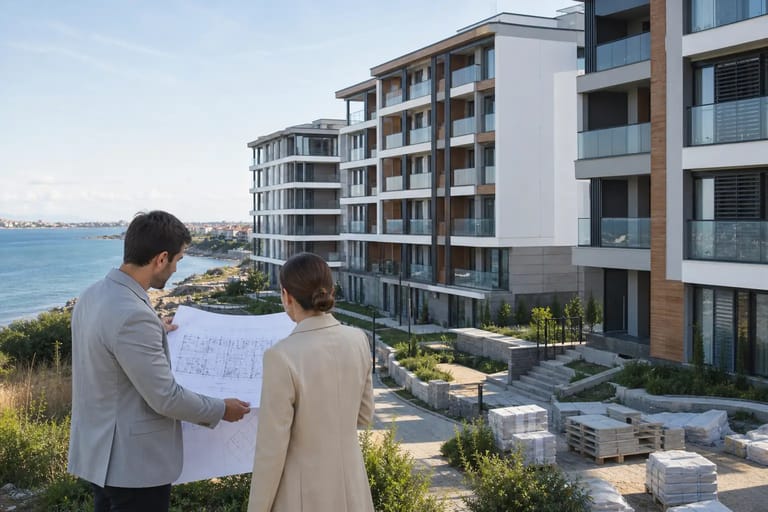
Act 14, Act 15, and Act 16 in Bulgaria These are key milestones in construction: conditionally "the structure is ready", "the object is technically handed over for acceptance", and "the building is commissioned". For the buyer, the most comfortable moment of the transaction usually occurs after the final occupancy permit, but the decision depends on the price, contract, developer, financing, and legal review.
In brief
- Act 14 usually signifies the completion of the rough construction: the building structure is erected, but the property cannot yet be lived in or used.
- Act 15 is related to technical readiness and the transfer of the object between construction participants, but this does not yet signify full commissioning.
- Act 16 is commonly referred to in everyday speech as the final stage after which the building can legally be used if that specific procedure is applicable.
- Purchasing before Act 16 may be more cost-effective, but it carries construction, legal, financial, and timing risks.
- Before payment, it's important to check not only the presence of acts but also the land, building permit, encumbrances, contract, payment schedule, and the developer's reputation.
- The rules may depend on the type of building, object category, and current practices of authorities, so it's better to make the final decision with a Bulgarian lawyer and technical expert.
Why are these acts so important for the buyer?
In the new property market in Bulgaria, buyers are often told: "The house already has Act 14", "we're waiting for Act 15", "Act 16 will be here soon". For local market participants, these are familiar references, but for foreign buyers, they may sound like a set of formalities. In practice, the stage of construction determines exactly what you are buying: a future apartment in the project, an almost completed object, or already commissioned real estate.
The main mistake is to perceive each act as equally reliable confirmation of safety. Act 14 is not equal to a ready apartment. Act 15 does not always mean that one can move in. Act 16 does not negate the need to verify documents, the quality of work, common areas, complex management, and the financial terms of the transaction. But it is the sequence of these stages that helps to understand where the construction promise ends and where the actual operation of the building begins.
This article looks at the topic from the buyer's perspective: when you can enter the project, which risks to consciously accept, what conditions to include in the contract, and when it's better not to rush with payments. Legal details in Bulgaria can change and depend on the specific object, so this material does not replace a consultation with a lawyer, notary, or technical expert.
What is Act 14 in Bulgaria?
Act 14 is usually associated with the completion of the main constructive stage of construction. In simple terms for the buyer, this means: the building has reached the rough construction stage, meaning there is a supporting frame, ceilings, and a basic "box". However, engineering systems, facades, finishing, common areas, connections, and landscaping may still be far from completion.
Purchasing at the Act 14 stage is not a purchase of ready housing in the usual sense. You are, in essence, agreeing to wait for the developer to pass subsequent stages and bring the object to a habitable condition. The contract is particularly important for stipulated timeframes, penalties for delays, object description, finishing specifications, the procedure for project changes, and money return conditions in case of significant violations of obligations.
Why do buyers even consider this stage? Often the reason is a more attractive price, greater selection of floors and layouts, and the opportunity to lock in terms in advance. However, savings must be weighed against the risk: construction may be delayed, market conditions may change, the developer may face financial or technical problems. Entering at this stage without professional verification is risky.
What is Act 15
Act 15 is often perceived as a sign that construction has significantly progressed and the object is being prepared for final commissioning. In practical terms, this is the stage at which construction participants confirm the technical readiness of the object for subsequent acceptance procedures. But for the buyer, it’s important to understand: Act 15 is still not the final permit for building use.
At this stage, the house may look almost finished. The facade is complete, windows are installed, common areas are finished, apartments are shown to buyers, and sometimes final work on utilities and landscaping is being conducted. This is why Act 15 is psychologically dangerous: the object looks complete, but legally it may still lack final approval for operation.
Purchasing after Act 15 is usually less risky than at earlier construction stages because a significant amount of work has already been completed and is visible. However, questions still remain: will the final act be obtained, are there any construction defects, are utilities connected, do actual parameters match the project, are there any disputes among project participants? Before signing final documents, these questions need to be verified.
What is Act 16 and why is it awaited?
Act 16 In conversational practice, it is often used synonymously with final commissioning of the building. Buyers usually ask: "Is there an Act 16?" Here, it is usually understood that the object has received the necessary occupancy permit and can be used for its intended purpose. The specific procedure and name of the document may depend on the object category and the applicable rules, so the wording must be verified according to the documents of the specific building.
For the buyer, having the final permit reduces one of the main risks: the risk that the constructed object cannot legally be used as housing or that the commissioning procedure will be delayed. This is especially important if you plan to live in the apartment, rent it out, arrange utility services, insurance, mortgage, or subsequent resale.
Nevertheless, Act 16 does not automatically make the transaction perfect. It does not guarantee that the apartment is defect-free, that the area fully meets expectations, that the complex has a reasonable maintenance fee, or that there are no debts, legal disputes, or management issues. Therefore, the final act is a strong plus, but not a substitute for a thorough legal and technical inspection.
Comparison of stages: what each act means for the buyer
| Stage | What it usually means | What it gives the buyer | Main risks |
|---|---|---|---|
| Act 14 | Rough construction and building structure are mostly completed | One can assess the location, building volume, view, and some layout decisions | There is still a long way to go before readiness, delays, changes, and financial risks of the developer are possible |
| Act 15 | The property is technically being prepared for final acceptance | One can see most of the actual result and work quality | The building may not yet be operational; remarks and procedures remain |
| Act 16 | Final stage of access for use, if applicable to this property | Significantly lower risk of being unable to use the building for its intended purpose | Risks remain regarding quality, contracts, debts, management, maintenance fees, and resale |
When it is safer to buy new construction
The most conservative approach is to buy after final commissioning. For a buyer who does not want to take construction risks, this is the most understandable strategy: the property is already built, it can be inspected, documents can be compared with the actual state, common areas can be checked, and confirmation of operational status can be requested.
However, the word 'safer' does not always mean 'better in all cases.' Buying at an earlier stage can be reasonable if the project is verified, the developer has a reliable history, the contract protects the buyer, payments are linked to real stages, and the risk amount is limited. But this is more of an investment logic, rather than a simple purchase of ready-made housing.
Practically, three scenarios can be distinguished. The first is for a family or retiree who needs an apartment for personal living without extra uncertainty: it's better to wait for final commissioning or at least not pay the main part of the price until then. The second is for an investor who is ready to take risks for a price: Act 14 or Act 15 can be considered, but only with legal support. The third is for a rental buyer: it is important to consider not only the commissioning of the building but also seasonality, complex management, maintenance fees, and short-term rental rules.
Buying at Act 14: when it is justified
The Act 14 stage is not suitable for everyone. It may be justified if the buyer understands well that the money is effectively frozen until the project's completion, and the promised timeline is not a guarantee of unconditional results. The earlier the stage, the more important it is to check not only the apartment but also the developer.
Particular attention should be paid to the payment schedule. It is undesirable to pay almost the entire cost long before the final commissioning if the contract does not contain clear protective mechanisms. A more reasonable structure is when payments are linked to verifiable stages, and a significant part of the amount is withheld until a key result is achieved. Specific wording should be prepared by a Bulgarian law specialist.
It is also important to understand that advertising materials do not always equal contractual obligations. The view from the window, pool, parking, landscaping, finishing materials, furniture, complex infrastructure—all essential must be documented in writing. If an element is crucial to your decision, it must be reflected in the contract or annex, not just in the verbal promise of the manager.
Buying at Act 15: a compromise between price and risk
Act 15 is often perceived as a reasonable compromise. The house can already be visually assessed: you can see the quality of the façade, staircases, elevator areas, yard, entrances, and layouts. The risk of an 'empty pit' is already gone, but the risk of final commissioning still remains. Therefore, the buyer needs to ask a direct question: what exactly remains before the use permit is granted and what remarks need to be addressed.
At this stage, a technical acceptance of the apartment is useful. Even if the building is new, there may be problems with slopes, ventilation, windows, humidity, electricity, flooring, waterproofing, and noise from engineering equipment. An inexperienced buyer might not notice defects that later require expenses. A technical specialist will help compile a list of remarks before final payment.
If the seller asks to sign the final contract before final commissioning, the buyer needs to evaluate the implications very carefully. It is important to understand who bears the risk of delays, whether part of the payment can be withheld, what happens if the authorities refuse to issue the final permit, what deadlines are considered acceptable, and what compensation is provided.
Buying after Act 16: what to check regardless
Even after Act 16, the buyer must act as an inspector, not as a tourist viewing the property. The final status of the building is an important filter, but a real estate transaction involves many other elements. This is particularly true for resort complexes, seaside apartments, properties with management companies, and homes with active resale.
Check whether the actual apartment corresponds to what is stated in the contract and documents. Clarify the area, shares in common parts, the availability of a parking space, storage, terrace, and type of use of the property. If there is a maintenance fee, you need to understand in advance how it is calculated, who manages the complex, what is included in the maintenance, and how conditions change.
If the apartment is being purchased for rental, it is useful to assess not only the legal feasibility of use but also practical expenses: management, cleaning, utilities, repairs, seasonality, agent commissions. There is a separate article on the site about apartments in Bulgaria for rent, and ownership expenses should be compared with material about hidden costs when buying real estate in Bulgaria.
Checklist for new construction buyers in Bulgaria
- Clarify the current stage. Request documentary confirmation, not just a verbal statement that 'the house is almost ready.'
- Check the rights to land and the project. It is important to understand who owns the land, on what basis the property is being built, and if there are any significant restrictions.
- Check the building permit. Its presence, compliance with the property, and relevance must be assessed by a specialist.
- Check the developer. Explore completed projects, legal and financial risks, owner reviews, and the quality of already delivered homes.
- Agree on a secure payment schedule. Do not rely solely on promised dates; focus on confirmed milestones.
- Document the apartment specifications. The layout, floor, area, finish, equipment, parking, and common parts must be described in writing.
- Conduct a technical inspection. Preferably before the final payment and signing the acceptance act of the apartment.
- Check the maintenance fee. Especially in resort complexes by the sea, where annual maintenance can significantly impact profitability and liquidity.
- Do not sign unclear contracts. The translation into Russian is convenient, but a legally significant version should be checked by a specialist familiar with Bulgarian practice.
- Leave a reserve for additional expenses. Notary, registration, banking, repair, and operational payments are best calculated in advance.
What terms should be discussed in the contract
The contract with the developer is the main tool for protecting the buyer until the final transfer of ownership. It should clearly outline the subject of the transaction, price, currency of payments, deadlines, responsibilities of the parties, transfer procedure, conditions for rectifying defects, and consequences of construction delays. The wording should not leave key issues for later.
The terms regarding the timeframe for obtaining final occupancy permits are especially important. If the developer promises Act 16 soon, the contract must address what happens if this does not occur. The buyer needs to understand in advance if they can withdraw from the transaction, have their payments returned, receive compensation, or withhold part of the amount until the obligations are fulfilled.
The description of the apartment's condition is equally important. "Turnkey", "rough finish", "furnished", "with equipment"—these terms can be interpreted differently. Specific details are needed: what work has been completed, what materials are used, what is included in the price, who connects utilities, who pays for meters, who rectifies defects after transfer.
Red flags: when it's better to stop
- The developer or agent refuses to show documents and suggests "first leaving a deposit".
- The buyer is rushed to sign the contract without a translation or legal review.
- The contract lacks clear deadlines, responsibilities for delays, and refund conditions.
- The price is significantly lower than similar properties without an understandable reason.
- The manager's promises do not align with the written terms.
- It is unclear whether the property will be used as housing, a vacation apartment, or another type of real estate.
- There is no clarity regarding the maintenance fee, management of the complex, and future expenses.
- The buyer is asked to pay a large part of the price in cash or through an opaque scheme.
Example of decision-making
Let's imagine a buyer choosing an apartment by the sea for personal vacation and occasional rental. The first property is cheaper and at the Act 14 stage. The second is more expensive but already has final approval. At first glance, the early property seems more advantageous, but the buyer needs to consider not just the price but the full risk: waiting time, likelihood of rental season delays, travel expenses, furnishing, upkeep, possible changes in conditions, and liquidity upon resale.
If the buyer is willing to wait, has a reserve of funds, and receives strong contractual protection, an early stage may be acceptable. However, if the apartment is needed for a specific season or if the buyer is not ready to navigate construction procedures, a property after final approval is usually more practical. In real estate, a low price often comes with uncertainty.
FAQ
Can you live in an apartment after Act 14?
Generally, no. Act 14 relates to the early construction stage and does not mean the building is suitable for habitation or legal use. The specific status must be checked based on the property documents.
Can you purchase an apartment after Act 15?
Such a purchase can be considered, but cautiously. Act 15 indicates a high level of readiness; however, final approval for occupancy may still be pending. It's advisable to withhold part of the payment until the final status is confirmed and to review the contract with a lawyer.
Does Act 16 guarantee that the apartment is defect-free?
No. Final building approval does not replace the technical acceptance of a specific apartment. Windows, walls, floors, ventilation, electrical systems, plumbing, humidity, common areas, and compliance with declared finishes should be checked separately.
What is more important: the notarial deed or Act 16?
These are different things. The notarial deed is related to the registration of ownership rights, while Act 16 concerns the operational status of the building. For a safe purchase, both aspects are important: ownership rights must be properly documented, and the building should have a legal status for use.
Is it worth buying cheaper before Act 16?
Sometimes this is justified for an investor who understands the risks and gets strong contractual guarantees. For a buyer who needs a ready apartment without construction uncertainties, it is safer to consider a property after the final acceptance.
Who should check the documents of the new building?
It is better to engage an independent Bulgarian lawyer, and for construction quality — a technical specialist. An agent and seller may be useful sources of information, but they do not replace independent verification of the buyer's interests.
Output
Acts 14, 15, and 16 in Bulgaria help to understand what stage the new building is at and what risk the buyer takes. The earlier the stage, the more dependence on the developer, timelines, and quality of the contract. The closer the property is to final acceptance, the easier it is to assess the actual condition and reduce uncertainty.
A practical rule is this: if you are buying for calm personal use, focus on a property with final permission and full verification. If you buy earlier for the price, treat the deal as an investment with risk: check the documents, fix the terms in writing, do not overpay in advance, and engage specialists before signing, not after problems arise.