
Plovdiv is best explored on foot in 1 day: start from the Old Town and Nebet Tepe, descend to the Ancient Theatre and Roman Stadium, have lunch in the Kapana area, and by evening head to the Main Street, Tsar Simeon’s Garden, or one of the viewpoints. This way you will see antiquity, the Bulgarian Renaissance, and a vibrant modern city without rushing.
In brief
- Main highlights for one day: Old Town, Ancient Theater, Roman Stadium, Dzhumaya Mosque with its square, Kapana district, and an evening walk in the center.
- Best format: a walking route with comfortable shoes; the historical part has many cobblestones, inclines, and uneven steps.
- Where to feel Old Bulgaria: on the streets of the Old Town, by the houses of the Bulgarian Renaissance, and in intimate museums housed in old mansions.
- What needs checking: working hours of museums, access to specific sites, ticket prices, fountain schedules, and seasonal events.
- If time is short: don't try to cover everything around Plovdiv; it's better to explore the center in depth than to spend the day on logistics.
Why Plovdiv deserves a full day
Plovdiv is often included in a route through Bulgaria as a stop between Sofia, the sea, and the mountains, but the city deserves more than just a quick visit; it invites a thoughtful stroll. Its value lies in the rare combination of layers: ancient ruins are not separate from the city but embedded in its fabric; nearby, Ottoman monuments, Bulgarian Renaissance houses, street cafes, galleries, and creative neighborhoods coexist.
For a first acquaintance, one day is a realistic minimum. You won't see all the museums or explore every hill, but you'll grasp the city's character: leisurely, warm, visually striking, and very textured. Unlike routes where you need to keep moving, Plovdiv reveals itself well on foot. The key is not to overload your plan.
If you're planning a broader route through the country, Plovdiv is conveniently considered a key stop alongside Sofia, the Rila direction, Veliko Tarnovo, seaside cities, and natural sites. But in this article, the focus is narrow: how to spend one rich but not exhausting day specifically in the city.
Optimal route in Plovdiv for 1 day
Below is a route that suits most travelers: without an early rush through museums, but with a good balance of history, views, food, and walking. The times are approximate: they depend on the season, pace, weather, queues, and how in-depth you go inside the sites.
| Time | The area | What to Do | Who it Suits Especially |
|---|---|---|---|
| Morning | Old Town and Nebet Tepe | Cobblestone streets, old houses, panoramas, first photos without the rush | For those who want to experience historic Plovdiv |
| Late Morning | Ancient Theater | Explore one of the city's main ancient monuments | History, architecture, and view enthusiasts |
| Afternoon | Roman Stadium and Dzhumaya Square | See the ancient layer in the center, take a pause at the mosque and cafes | Those who appreciate the contrast of eras |
| Lunch | Kapana | Eat, peek into galleries, stroll through the small streets | For those who value a modern urban atmosphere |
| The second half of the day | Main street and center | Leisurely stroll, shops, ice cream, coffee, street life | For families, couples, those tired of climbing |
| Evening | Garden of Tsar Simeon or hill | Sunset, relaxation, final views, a calm end to the day | For those who want to finish the route at a leisurely pace |
Morning: Old Town and Nebet Tepe
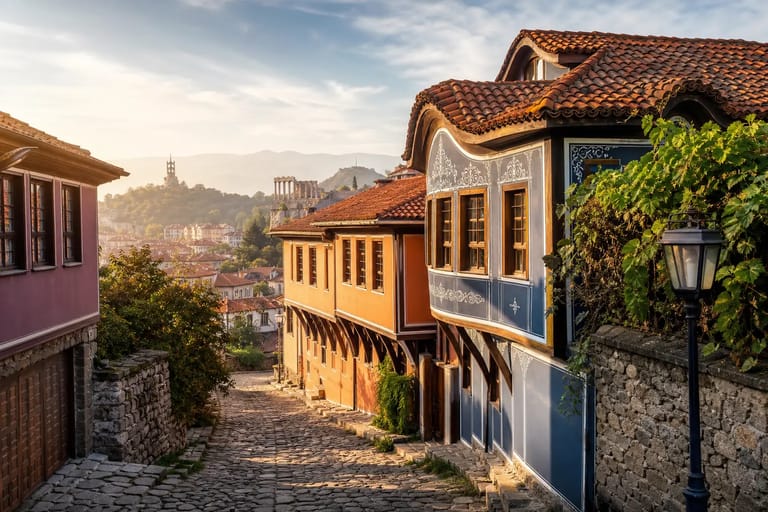
Start with the Old Town. It’s the best way to instantly understand why people come to Plovdiv. Narrow streets, cobblestone pavements, gates, wooden balconies, painted facades, and old mansions create a sense of a vibrant historical quarter rather than a museum setting. It’s important to move slowly here: Plovdiv doesn’t reveal itself through a quick list of points; it unfolds through details.
The Old Town is linked to the Bulgarian National Revival—a period that is vividly reflected in the architecture of wealthy urban houses. Many buildings today operate as museums, galleries, or cultural spaces. If you only have one day, it’s not advisable to visit every museum in a row. It's better to choose one or two houses, if they are open and you are interested in the interiors, daily life, and urban culture of that time. Check current visiting hours and conditions before your trip.
Nebet Tepe is one of Plovdiv’s historic heights and a convenient viewpoint. From here, the city's terrain is clearly visible: hills, roofs, modern buildings, and the old part nearby. It’s not only a place for photos but also a good pause at the beginning of the day. If the weather is hot, come in the morning: the climbs and cobblestones in the second half of the day can be exhausting.
How to explore the Old Town without haste
- Don’t plan your route solely by GPS: sometimes it's better to turn onto a quiet street and return to the main line later.
- Look up: decorative facades, windows, wooden protrusions, and roofs are often more interesting than shop windows at eye level.
- Don’t rush to photograph only panoramas: doors, stone walls, and courtyards convey the atmosphere just as well.
- Take care of your knees and shoes: the cobblestones are beautiful but not the most comfortable for thin soles.
Ancient theater: the main symbol of the city
The Ancient Theater of Plovdiv is one of the most recognizable monuments of the city. It is located on a slope and makes a strong impression precisely because of its context: stone rows, stage, view of the city, and the feeling that antiquity is not separated from everyday life here. In warm seasons, cultural events may take place in such venues, but the schedule always needs to be checked separately.
If the site is open to visitors, allow time not only for tours but also for a pause. The rule of Plovdiv works well here: fewer points, more attention. Even if you are not an ancient history expert, the theater helps you feel how deep the cultural layer is in the city.
Practical advice: if the day is short or you are traveling with children, it’s better to make the Ancient Theater a required stop and shorten your visit to some museums. This is one of those sites that leaves a lasting visual impression of Plovdiv.
Roman Stadium, Dzhumaya Square, and the city center
After the Old Town, it makes sense to descend to the central part, where fragments of the Roman stadium are visible. The peculiarity of Plovdiv is that ancient remains are right among cafes, shops, and pedestrian streets. This is not a 'dead' archaeological park, but part of a modern urban scene.
Nearby is Dzhumaya Square and the Dzhumaya Mosque—a notable monument of the Ottoman period in the city center. It’s important to treat religious sites with respect: do not disturb those praying, maintain quietness, and if you wish to enter, check in advance whether it is allowed for visitors and what rules apply.
This part of the route is great for a short break. It’s convenient to grab coffee, try a dessert, sit in the shade, and decide how much energy you have left for the second half of the day. If you came for a day from another city, it makes sense to take a longer pause in the center rather than trying to walk non-stop until evening.
Kapana: where the old fabric of the city became modern
Kapana is a district of small streets, establishments, workshops, bars, galleries, and street life. It’s often described as the creative quarter of Plovdiv. For a day trip, it’s an ideal place for lunch: you don't have to stray far from the historical center, but the atmosphere is different—less museum-like, more urban and contemporary.
The name of the district is often associated with a sense of a maze: it’s easy to weave through short streets, return to a familiar corner, and find a new café around the bend. But it's a pleasant loss of orientation, not a logistical problem. One or two hours in Kapana is sufficient for the day: to eat, stroll aimlessly, and peek into a couple of small spaces, if they are open.
Don't expect Kapana to replace the Old Town. It’s not about the patriarchal ‘old Bulgaria’ in the literal sense, but about how the historical urban environment is being reused today. The contrast is what makes the route cohesive: in the morning you see old mansions and antiquity, in the afternoon— a vibrant urban layer.
Where to feel the old Bulgaria
If your goal is not just to tick off items on a map, but to feel the old Bulgaria, look for a combination of experiences rather than just one 'most authentic' site. In Plovdiv, it consists of architecture, terrain, courtyards, artisanal details, the smell of coffee, quiet stairs, and surprising views between houses.
Old Houses and Museum Mansions
The houses of the Bulgarian Renaissance are an important part of the identity of Old Plovdiv. Their facades are often bright, symmetrical, with wooden elements and richly decorated interiors. If there is an ethnographic or house museum open, it may provide more understanding than yet another panoramic photo. But choose according to your interest: architecture and lifestyle lovers will enjoy it, while those traveling with small children or very tired may be satisfied with an exterior view.
Quiet Streets Instead of Main Attractions
The most memorable part of Plovdiv is often found between the attractions. Step away for a few minutes from the crowd, turn into a side street of the Old Town, find a courtyard with a stone wall or a small gallery. It is these fragments that give you a sense of an old Balkan city, not just a tourist center.
Evening Light on the Hills
Plovdiv is known for its hills, and while not all are equally convenient for a short visit, one evening height can become a strong finale of the day. Choose a viewpoint according to your strength and the weather. After a hot day, the ascent may be tougher than it seems on the map, so don’t plan it as a mandatory stop at any cost.
Itinerary for Different Types of Travelers
The same city can be viewed in different ways. Below is a practical scheme that will help tailor the day to your interests.
| Type of Trip | Must-see | Can be shortened | Main Advice |
|---|---|---|---|
| First Time in Bulgaria | Old Town, Ancient Theatre, Roman Stadium, Kapana | Additional Museums | Gather impressions of different eras, not just photos of sites |
| With Children | Short Old Town, theatre, center, park | Long ascents and several museums in a row | Take breaks more often than you plan |
| History Lovers | Ancient Theatre, Roman Stadium, Old Town, one museum | Long shopping and café route | Check the availability of attractions in advance |
| Photographers | Nebet Tepe in the morning, Old Town, facades, evening hill | Long indoor lunch | The best shot is often found in side streets |
| Slow Tourism | Old Town, one café, Kapana, garden | Trying to see everything | Choose fewer points but give the city time |
Practical Checklist Before the Walk
- Footwear: comfortable, with a non-slip sole; there are many cobblestones in the Old Town.
- Water: especially important in summer and when climbing hills.
- Cash and card: payment conditions vary by location, so it’s best to have both options.
- Plan B for rain: mark one or two museums or cafes in advance, where you can wait out bad weather.
- Check the hours: before heading out, verify the opening times of museums, theaters, galleries, and seasonal attractions.
- Pace: allow time for aimless turns; in Plovdiv, this is part of the route, not a mistake.
- Dress code: for religious sites, choose a modest appearance and respectful behavior.
Where to eat and take a break
For lunch, it’s easiest to choose Kapana or the streets near the central pedestrian area. There you can find various formats: from coffee and pastries to a full meal. Specific establishments, ratings, and prices change, so it’s best to check current reviews, menus, and hours before your visit.
If you want more of a local atmosphere, look for places not just in the most noticeable terraces on the main corners. Sometimes quieter cafes are located in side streets where there’s less foot traffic and it’s easier to relax. However, during the high season or city events, popular places can be busy, so don’t tie your entire route to one restaurant.
A good strategy is to have a light coffee or breakfast before the Old Town, then a full lunch in Kapana, and in the evening enjoy dessert or a drink in the center. This way, you don’t waste daytime traveling long distances for food.
What not to do in one day
- Don’t try to fit in all the museums. Plovdiv is best appreciated through a walk and the layers of the city, rather than a marathon through the halls.
- Don’t plan long trips without necessity. The surroundings can be interesting, but for your first day in Plovdiv, they often take up too much time.
- Don’t underestimate the terrain. On the map distances may seem short, but the climbs, heat, and cobblestones slow down the pace.
- Don’t leave the Old Town for the very end. It’s beautiful in the evening, but if you get tired, the main part of the route may be rushed.
- Don’t build your day around a single schedule. If a fountain, concert, or museum turns out to be unavailable, you should have an alternative relaxing plan.
If you only have 3–4 hours
Sometimes you can only see Plovdiv between transfers. In this case, the route needs to be significantly shortened. The optimal version: Old Town — Ancient Theatre — descent to the Roman stadium and Djumaya Square — a short loop in Kapana. This will provide a basic impression of the city without long sitting in cafés and museums.
If time is very limited, don't climb several hills and don't go far from the center. In Plovdiv, compactness works in your favor: even a short route can be rich if you choose the sequence wisely.
If you have a full day until late evening
With a more relaxed schedule, add one museum in the Old Town, a long lunch in Kapana, and an evening park or lookout point. Tsar Simeon’s Garden is great for a quiet end to the day in the center. In warm season, the area near the fountains can be particularly lively, but schedule and operational hours of any light or musical programs should be checked on current city resources.
Another option is to return in the evening to the Old Town. After the daytime flow, it may be perceived differently: soft light, emptying streets, less noise. But consider lighting, weather, and personal safety, as in any unfamiliar city.
Safety, accessibility, and seasonal nuances
Plovdiv in the tourist center is generally convenient for independent strolling, but basic attentiveness is always necessary: keep an eye on your belongings in crowded places, don’t leave documents and devices unattended, and walk cautiously on cobblestones after rain. If you are traveling with elderly relatives, small children, or a person with limited mobility, assess the inclines and street conditions in advance.
In summer, the main challenge is the heat and open areas on the hills. In winter or rainy days, the route may become less comfortable due to slippery stones and shorter daylight. Spring and autumn are often considered the most pleasant seasons for walks, but specific weather always matters more than the calendar.
FAQ: frequently asked questions about Plovdiv for one day
Can Plovdiv be visited in 1 day without a guided tour?
Yes, the central route can be navigated independently. The Old Town, Ancient Theater, Roman stadium, Djumaia square, and Kapana are logically connected for walking. A tour is helpful if you want to understand the historical layers more deeply and not waste time on independent preparation.
What must-see places in Plovdiv for a first visit?
The minimum set: the Old Town, Nebet Tepe, Ancient Theater, fragments of the Roman stadium, Djumaia square, and the Kapana area. If you still have energy, add one mansion museum or an evening stroll through Tsar Simeon’s Garden.
Is Plovdiv suitable for a trip with children?
Yes, if you don't overload the day. Children may find it physically challenging to walk for long periods on cobblestones and inclines, so it's better to alternate the Old Town with a park, ice cream, short stops, and clear visual landmarks, like the Ancient Theater.
Do I need to buy tickets in advance?
For a typical city walk, tickets are not required, but specific museums, archaeological sites, and events may have their own rules. Since conditions change, it’s advisable to check official information or current pages of specific venues before your trip.
Where is the best place to stay if I have only one night in Plovdiv?
For a short visit, it's more convenient to choose accommodation within walking distance of the Old Town, Main Street, or Kapana. This way, you won’t waste time on transport and can head out for an evening walk without complicated logistics. Check reviews about noise, parking, and access to the building before booking.
Is it worth going to Plovdiv from Sofia for one day?
This format is possible if the transport schedule is convenient and you are ready for an early departure. However, for a more relaxed acquaintance, it’s better to stay at least one night: evening Plovdiv and the morning Old Town offer a different quality of experience.
Brief conclusion
Plovdiv in 1 day is not a race through attractions, but a stroll through the ages. The best route starts in the Old Town, passes through ancient monuments, takes a lively pause in Kapana, and ends in the center or at a viewpoint. If you leave room in your plan for random streets, coffee, and quiet, the city will reveal its essence — old Bulgaria not as a museum, but as a living environment.