

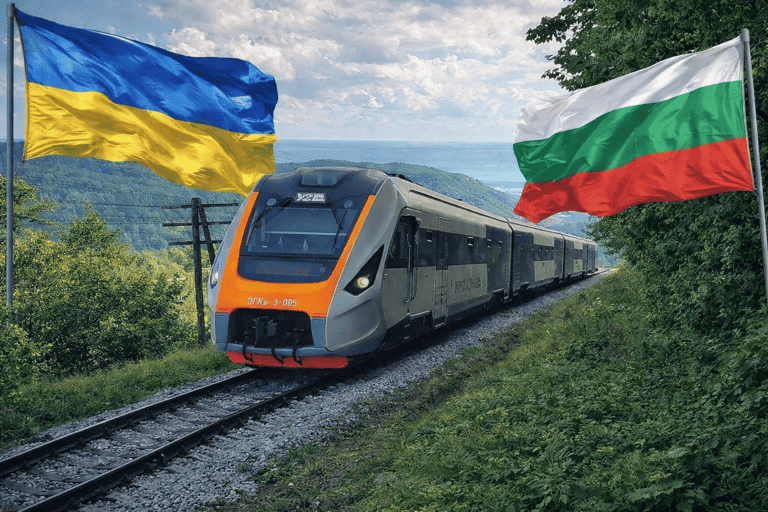
Ukraine and Bulgaria are planning to launch a new international railway route between Kyiv and Varna. The train is expected to pass through Romania and, according to preliminary plans, may start operating in early June 2026.
The project is in the coordination stage, but it is already being considered one of the notable transport projects for the summer season. This is not just about a new train, but an attempt to create an additional route to the Black Sea, which will be in demand among tourists, families with children, organized groups, and passengers preferring ground transportation.
Against the backdrop of high interest in trips to Bulgaria and a sustained demand for alternative means of transport, this route seems a logical continuation of transport cooperation between Ukraine, Romania, and Bulgaria. It is important, however, to assess the project without inflated expectations: at this stage, it is about preparation, agreeing on conditions, and testing the actual feasibility of the route.
What is known about the launch of the train Kyiv – Varna
| Parameter | Data |
|---|---|
| Route | Kyiv – Varna |
| Countries along the route | Ukraine, Romania, Bulgaria |
| Preliminary launch | Early June 2026 |
| Price range | International passenger train |
| Estimated travel time | Up to 30 hours |
According to preliminary information, the parties have already agreed on the basic configuration of the route and the schedule, taking into account passenger convenience. The next step is the final agreement on fares, technical details, and conducting a test run.
Route of travel: how the train will go to Varna
According to preliminary agreements, the train will pass through several major cities and transport hubs. The proposed route scheme looks as follows:
- Kyiv
- Lviv
- Chernivtsi
- Suceava
- Bucharest
- Varna
This route will connect the capital of Ukraine with the Bulgarian coast of the Black Sea through Romania. From a transport perspective, it means the creation of a new international corridor that may be in demand during the summer season.
The intermediate stops are particularly significant. Lviv and Chernivtsi traditionally remain important hubs for passenger transport in the western direction. Suceava and Bucharest provide connections with the Romanian infrastructure, while Varna serves as the final point of the route as one of the main coastal cities of Bulgaria.
Why this route attracted attention
Interest in the project is explained by several factors. Firstly, Bulgaria remains a popular destination for summer vacations. Secondly, some passengers are interested in ground travel, especially families, children’s groups, or those staying for an extended period. Thirdly, the very fact of having direct or semi-direct rail links between Ukraine and the Bulgarian coast has long been viewed as a promising idea, though such initiatives have rarely reached the practical stage.
Additional interest in the route is also linked to the seasonality of tourist flow. It is at the beginning of summer when demand for trips to the sea increases, thus making the launch of such a route in June logical in terms of passenger traffic.
How long will the trip take
The estimated travel time is declared to be up to 30 hours. For an international route crossing several borders, this is an expected figure. The final duration will be influenced by several factors:
- Length of the route;
- Border and customs procedures;
- Timetable coordination between countries;
- Technical features of the railway infrastructure.
At the same time, it is emphasized in the project discussions that the configuration of the route is being developed to avoid unnecessary delays of rolling stock. This is important not only for passenger comfort but also for the cost-effectiveness of the route.
If the route is indeed optimized, the train can occupy its niche as a predictable and straightforward way to reach the coast without transfers between several modes of transport.
Ticket prices: what is known at the moment
At the time of preparing the route, final tariffs have not been approved. However, it is already known that the Romanian and Bulgarian sides have agreed on the possibility of including the route in the PSO state order mechanism. This model is used to support socially significant transportation and may help keep ticket prices at an acceptable level.
This means that the trip price could potentially be lower than with a fully commercial route model. For passengers, this is one of the key factors, as the ticket price will largely determine the demand for the Kyiv – Varna train via Romania.
It is important to understand that the final price will depend not only on subsidies but also on technical expenses, international agreements, train composition, frequency of services, and the revenue distribution model among the parties.
Who is involved in launching the project
The route is being implemented in a tripartite format. The project involves the railway and transport structures of Ukraine, Romania, and Bulgaria. From the Ukrainian side, it involves the national railway operator and relevant authorities responsible for the development of transport communications.
The project is being discussed at the interstate level and is part of a broader agenda to develop transport corridors, passenger routes, and connectivity between countries in the region.
From a practical point of view, this means that launching the route requires the synchronization of several systems at the same time: schedules, tariffs, technical standards, border procedures, and passenger services.
Why the Kyiv – Varna train may be in demand
The potential audience for the route is quite broad, although it is unlikely to be a mass demand like the most popular domestic routes. Nevertheless, the train may be in demand among several categories of passengers.
Tourists
For those planning a vacation in Bulgaria, the train offers a clear alternative to air and bus transportation. This is especially relevant for passengers who prefer a pre-planned trip without the need to search for connections and additional transfers.
Families with children
Long summer trips often require a larger amount of luggage and more straightforward logistics. In this regard, the train has its advantages, as it allows for more comfortable transportation of belongings and does not depend on airline rules regarding hand luggage and checked baggage.
Organized groups
The project may be particularly interesting for children's groups, camps, sports teams, and organized tourist trips. For this passenger category, a convenient railway route to the sea looks the most practical.
Passengers who prefer ground transportation
There is a stable audience that, for various reasons, chooses the train over the plane. For such passengers, the availability of a direct route to the sea can be a decisive argument.
Comparison with other ways to reach Bulgaria
To understand the prospects of the route, it's important to compare it with other travel formats to Bulgaria.
| Parameter | Train | Plane | Car |
|---|---|---|---|
| Travel time | Longer | Faster | Depends on the route and borders |
| Cost | Potentially average or lower | Often higher | Variable |
| Luggage | More flexible conditions | Tighter rules | Maximally free format |
| Comfort on the way | Stable format for long trips | Fast, but with limitations | Depends on the driver and the road |
A train cannot replace aviation and will not displace car travel, but it can occupy its own niche. Its main advantage is the predictability of the route and the ability to reach the destination without multiple transfers between different modes of transport.
Realistic launch: what can affect the project
Although the news of the Kyiv – Varna train launch has already attracted attention, at this stage it is important to maintain a realistic view of the situation. International railway projects require not only political agreements but also significant technical preparation.
In practice, the following factors can affect the launch:
- final approval of tariffs;
- approval of the schedule;
- border procedures;
- readiness of infrastructure at all sections;
- economic feasibility of the route;
- real demand from passengers.
That is why the next step should be a test run. It will show how viable the route is in practical terms and which parameters need adjustment before the regular service starts.
Significance for Varna and the Bulgarian coast
For Varna, the launch of such a train means expanded transport accessibility. The Bulgarian seaside city receives an additional channel for tourist influx, which is not directly dependent on air travel. This is especially important during periods of high seasonal demand when the tourist infrastructure needs a stable and diverse transport flow.
From the region's perspective, the effect may manifest in several directions:
- growth in the number of tourists from Ukraine;
- increase in long trips to the sea;
- enhanced convenience for organized groups;
- a more flexible model for trips to Bulgaria.
However, one should not expect an immediate leap. Even if the train launches in the summer of 2026, the impact on the market will manifest gradually and will depend on the frequency of runs, ticket prices, and schedule stability.
What this could change for the tourist market
For the tourism industry, the mere fact of the appearance of an additional railway route is already significant. The more ways to reach Bulgaria, the higher the overall accessibility of the destination. This is especially important in conditions where travelers compare not only the cost of the trip but also its predictability, convenience, and logistical simplicity.
The appearance of the Kyiv – Varna route may:
- increase the number of independent trips;
- support organized tourism;
- stimulate longer stays in Bulgaria;
- expand the seasonal passenger flow.
For the market, this means not a revolution, but a gradual expansion of transportation opportunities.
Impact on the real estate market: without exaggeration
Although the main news is related to the railway connection, the project also has indirect significance for the real estate market in Bulgaria. However, it is important to discuss only sober and logical effects here.
The emergence of a new route may affect the market in the following ways:
- the region will become more accessible to potential buyers;
- the number of personal trips for property viewings will increase;
- some passengers will consider a longer stay;
- interest in renting and secondary living by the sea will rise.
At the same time, the train itself will not cause a sharp price increase and will not change the market in one season. Its significance lies in increasing the region's accessibility and expanding logistics options for those already considering Bulgaria as a place for recreation, investment, or property purchase.
Practical significance for real estate buyers
For some clients, the Kyiv – Varna train may become a convenient way to arrive in Bulgaria without flying. This is especially relevant in cases where more personal belongings are required, to spend several days in the country, or to combine the trip with multiple property viewings.
From a practical point of view, the new route can offer the following advantages:
- simplification of trip planning;
- the ability to arrive in the region by ground transport;
- convenience for longer visits;
- more flexible organization of viewings.
For buyers, this is not a key factor, but a useful additional tool that makes the trip to Bulgaria more accessible.
Service for clients in Bulgaria
Real estate agency InReal4u works with clients arriving in Bulgaria by both air and ground transport. For those considering buying real estate on the coast, the company provides comprehensive support.
- meeting and transfer upon arrival;
- organization of property viewings;
- selection of real estate according to the client's goals;
- transaction support;
- consultations on properties and locations.
This format is especially convenient for clients who arrive for a limited time and want to plan their trip, viewings, and business meetings in advance. With the launch of the Kyiv – Varna train, such a service may be additionally in demand from those who will travel to the region by train.
What will happen next
Currently, the project is in preparation, and several stages need to be completed for its launch. Among them:
- final approval of tariffs;
- preparation of a test flight;
- approval of the schedule;
- synchronization of operators' operations across all countries;
- assessment of the economic and organizational efficiency of the route.
Only after these stages are completed can we talk about a full launch of regular services. Until that moment, the project remains a promising initiative but not a fully realized route.
Main conclusion
The project to launch the train from Kyiv to Varna via Romania could become one of the notable transport events of the summer season in 2026. Its main value lies in the fact that it offers a new way to reach the Bulgarian coast, enhances transport connectivity between countries, and provides passengers with an additional option to travel to the sea.
At this stage, several key conclusions can be drawn:
- the route is in the practical preparation stage;
- the preliminary launch is planned for early June 2026;
- the estimated travel time will be up to 30 hours;
- the ticket prices have not been finalized yet, but the subsidy mechanism is being discussed;
- the project may be in demand among tourists, families, groups, and passengers preferring land transport.
If the train is indeed launched and demonstrates steady demand, it could occupy its niche in the system of international transportation between Ukraine, Romania, and Bulgaria. In this case, we would be talking not just about a seasonal news but about the formation of a new stable route to the Black Sea.