
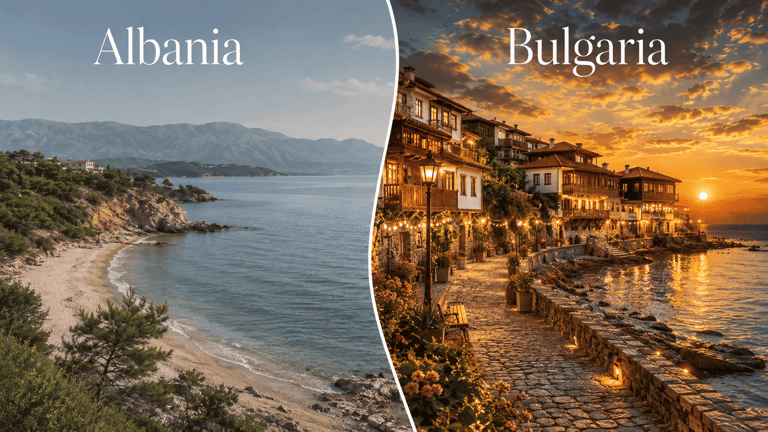
In recent years, more and more property buyers, investors, and those considering moving to Europe have begun to compare Bulgaria and Albania. At first glance, these countries may indeed seem similar: both are located in the Balkans, both have access to the sea, both offer more affordable prices compared to Western Europe, and both are actively developing tourism and attracting foreign attention.
But this similarity is largely superficial. Looking deeper, Bulgaria and Albania are two completely different markets. Bulgaria is an EU member state, part of the Schengen Area, and a member of the Eurozone. This means a European legal system, the euro, clearer banking procedures, a higher level of property protection, and a significantly more predictable environment for living, doing business, and purchasing real estate.
Albania is a candidate country for the EU. It is indeed moving towards European integration; however, the path to membership can be long, complicated, and politically dependent. Negotiations with the European Union do not guarantee swift accession. They require profound reforms in the judiciary, anti-corruption efforts, public administration, financial control, property rights protection, and other areas.
This is where the main difference begins. Bulgaria is already within the European system. Albania is only striving to get there. Bulgaria already uses the euro. Albania maintains its national currency. Bulgaria is already embedded in the European legal space. Albania is still undergoing a challenging reform process. The Bulgarian real estate market is more mature, understandable, and time-tested. The Albanian market is growing rapidly, but this growth increasingly raises questions: is it overheated, how safe are investments, and what happens if expectations are not met.
This article is not written to instill artificial fear. Its purpose is to soberly explain to the buyer: beautiful sea, low prices, and promises of future growth should not replace safety, construction quality, legal clarity, market transparency, and real property protection.
The main conclusion: Bulgaria is a market of stability, Albania is a market of increased risk.
In brief, Bulgaria is better suited for those who want to buy property, relocate, start a business, or invest in a clear European environment. It is not an ideal country, but its main advantage is predictability. Here, there are European rules, the euro, Schengen, a long-established real estate market, notarial practices, a banking system, a clear tax model, and a higher level of institutional protection.
Albania may look attractive in photos, advertisements, and investment presentations. It is often presented as the 'new Croatia,' 'new Greece,' or 'the last undervalued country in the Mediterranean.' But such phrases should raise caution for buyers. When a market is marketed through the dream of rapid growth, low entry costs, and future EU membership, one must be especially vigilant regarding the risks.
The main risk of Albania is not that the country is bad. The main risk is that an overly beautiful investment myth has formed around it. Buyers are shown the sea, new complexes, promised returns, future Europe, and growing tourism. However, often lingering questions remain off-screen: who is building, to what standards, how is property rights verified, how stable is the price, is there real demand outside the season, how does the court operate, how protected is the foreign buyer, who manages the property, and can the property be sold without losses in a few years.
In Bulgaria, such questions also need to be checked. But the starting position is different: Bulgaria is already in the EU and the Eurozone, which means that buyers have more protective tools and less systemic uncertainty.
Safety and crime: why this is one of the key factors in choice.
When a person chooses a country to live in or buy property, they often start with price, sea view, distance to the airport, and potential yield. However, in practice, one of the most important factors is safety. Safety of the area, safety of the deal, safety of property, safety of family, safety of capital.
In this sense, Bulgaria has a significant advantage: it is perceived as a calm and safe country for everyday living. In large cities, resort areas, and tourist spots, as everywhere, petty thefts, domestic conflicts, fraud, or issues with unscrupulous sellers may occur. But the level of everyday street threat for an ordinary person in Bulgaria is generally low. For families, retirees, property owners, and those who want to live peacefully, this is a serious argument.
It is important to state honestly: Bulgaria is not a country without crime. Like many countries in the region, it has problems with corruption, the gray economy, and individual criminal schemes. But for property buyers and ordinary residents, it is important to differentiate between two levels: everyday safety and systemic risks. In everyday life, Bulgaria usually appears calmer and clearer, especially if one chooses normal neighborhoods, checks documents, and works with legal intermediaries.
The situation in Albania is more complicated. The country is actively developing, attracting tourists and investors, implementing reforms, but international reports and expert assessments continue to point to serious challenges related to organized crime, corruption, money laundering, and the weakness of certain institutions.
For a tourist who has come for a week by the sea, these risks may be almost invisible. They will see the beach, restaurants, hotels, hospitable people, and beautiful nature. But a property buyer must look deeper. They are not only interested in the safety of evening walks but also in capital security: is there a risk that the property was built with violations, that the documents are not perfectly arranged, that the market is overheated, that money in the real estate sector comes from opaque sources, and that state institutions will not be able to quickly and effectively protect their interests in a disputed situation.
This is why crime in the context of Albania is not just a question of 'is it dangerous to walk the streets.' A much more important question is: how transparent is the economy, how clean is the real estate market, and how strong are the institutions that should protect the buyer.
Organized crime and money laundering: the hidden risk of the real estate market
One of the most sensitive issues for Albania is the connection between real estate, construction, and opaque cash flows. This is not a topic of gossip but a real subject of discussion in international and local analytical materials.
When the real estate market grows too quickly, especially in a country with limited domestic demand and relatively low incomes, the buyer should logically question: what is driving the price increase? Is it real demand? Tourism? Foreign investors? Or is part of the growth supported by opaque capital and speculative expectations?
For the buyer, this is extremely important. If real estate prices are rising not only due to real demand, tourism, and economic development but also because of opaque cash flows, the market becomes less healthy. Externally, it may look strong: cranes, construction, new complexes, rising prices, beautiful presentations. But internally, such a market may be vulnerable. If the flow of money weakens, if control increases, if the political or banking environment changes, prices may stop rising or even adjust sharply.
This is the risk of a 'bubble.' A bubble forms when expectations of future growth become detached from real incomes, actual rental demand, the real quality of infrastructure, and the market's real capacity to absorb new properties. In Albania, such signs need to be assessed very carefully, especially in Tirana and in popular coastal areas.
The Bulgarian real estate market is not ideal either. There are also substandard properties, overpriced resort complexes, weak management companies, and cases of unscrupulous sellers. But Bulgaria is in the EU and the Eurozone, which means its financial and legal system operates within a stricter European framework. This does not provide absolute protection but reduces the risk that the market will develop entirely outside control.
Quality of construction: why Bulgaria offers more predictability
For property buyers, the quality of construction is one of the main concerns. A beautiful rendering, a sea view, and promises of high returns do not matter if cracks, leaks, communication issues, illegal changes to the project, poor sound insulation, lack of proper management of the building, or difficulties with commissioning arise in a few years.
Bulgaria has a more mature construction market. This does not mean that all Bulgarian properties are of high quality. The country has an old housing stock, panel houses, controversial resort projects, unsuccessful complexes, and properties built during construction booms with varying quality levels. But buyers have more experience, more specialists, more reliable procedures, more judicial and notarial history, and more information about areas and developers.
In Bulgaria, it is easier to understand exactly what you are buying. There is an established practice of checking the notarial deed, the cadastre, the usage permits, debts, the management company, land status, infrastructure, and communal obligations. There is a market for appraisers, lawyers, banks, insurers, management companies, and agencies that have long worked with foreigners.
In Albania, the construction market is developing very quickly, especially in Tirana and along the coast. Rapid growth in itself is not a problem. The problem arises when construction outpaces quality control, infrastructure, municipal planning, and the real needs of the market.
In such conditions, buyers should ask more questions: who is the developer, what completed projects do they have, have there been legal disputes, how is the land prepared, are there permits, does the property comply with the project, are communications connected, who will manage the building, how are parking, water, sewage, electricity, and road access issues resolved.
The biggest risk in Albania is buying not property, but a promise. A promise of a future resort, a future road, future demand, future EU membership, future price growth. But real estate should be assessed not by future promises, but by what already exists: documents, quality of construction, infrastructure, liquidity, and clear legal protection.
The Albanian real estate market: potential or bubble?
Albania is actively marketed today as a growth market. The same arguments often appear in promotional materials: 'prices are still low', 'the country will soon join the EU', 'tourism is growing', 'the coast is undervalued', 'this is the new Croatia', 'now is the time to enter.' On an emotional level, such logic works. But buyers need to remember: the more aggressively the market sells future growth, the more careful they need to check the fundamentals.
Tourism growth in Albania is indeed present. The country has become more popular, its coast is being actively discussed, and foreign tourists are coming more frequently. But tourism does not always automatically mean sustainable real estate returns. The tourist flow can be seasonal. Tourists may come for a short time and choose hotels over private apartments. Infrastructure may not withstand peak loads. Competition among rental properties can quickly rise if too many apartments are built.
The second question is the purchasing power of the local population. If housing prices rise faster than incomes, the market becomes dependent on foreign buyers, speculative capital, and expectations. This is a dangerous construct. As long as interest is high, everything looks good. But if external conditions change, liquidity can vanish. It becomes harder to sell a property than to buy one.
The third question is the quality of properties. In a developing market, projects often emerge that look nice in presentations but have weak engineering aspects, poor management, overloaded locations, or legal nuances. For investors, this is critical because returns depend not on the image but on operation: who rents the property, who maintains it, how much repairs cost, how complaints are handled, how utility bills are paid, and whether there is real occupancy outside of the high season.
In Bulgaria, the risk of a bubble may arise in certain segments—such as in overheated areas of Sofia or some resort locations. However, in general, the Bulgarian market is more proven over time. It has already gone through periods of boom, correction, recovery, and stabilization. Buyers can analyze history, compare areas, observe actual transactions, and understand which properties are liquid and which are not.
The Albanian market is still largely based on expectations. And expectations are the most dangerous foundation for investments.
EU: Bulgaria is already in, Albania is still in negotiation process.
One of the main advertising arguments for Albania is its future integration into the European Union. Buyers are told: 'Buy now, later the country will join the EU, prices will rise.' At first glance, this sounds logical. But in practice, the path to the EU can be long, complex, and politically unstable.
Albania received EU candidate status back in 2014. The negotiation process only noticeably intensified years later. Even if the country shows progress, negotiations with the EU are not a formality. They require deep reforms in the judicial system, combating corruption, public administration, human rights, competition, public procurement, financial control, ecology, agriculture, and other areas.
The 'Fundamentals' cluster is especially important. It relates to the rule of law, democracy, the judiciary, and combating corruption. This cluster opens first and closes last. Therefore, even formal progress does not mean that the country will quickly become an EU member.
In this sense, Bulgaria is in a completely different position. It is already an EU member. It is already part of Schengen. It has already adopted the euro. This is a fundamental difference. Bulgaria does not promise to become European someday. It is already part of the European legal and financial space. Albania sells expectation. Bulgaria offers existing status.
Why it is risky for a buyer to believe in the simple formula 'Albania will become the EU—prices will rise.'
The formula 'the country will join the EU, and therefore real estate will increase in value' is overly simplistic. In reality, prices depend not only on political status but also on economic quality, population income, bank lending, infrastructure, legal system, trust, liquidity, demographics, and sustainable demand.
Even if Albania continues its movement towards the EU, this does not guarantee automatic price growth for each property. Moreover, if the market has already factored in the expectation of accession, then after actual progress, the growth may be limited. And if the accession is delayed or reforms face problems, expectations may be revised.
The buyer should ask themselves: what am I buying—real value or hope for future revaluation? If a property is worth its price today, has documents, quality, infrastructure, demand, and liquidity, it may be interesting. If, however, the entire logic of the purchase relies on the phrase 'it will be EU later,' that’s already speculation.
Bulgaria is calmer in this regard. There’s no need to wonder if the country will be in the EU. It already is. There’s no need to wait for the euro. The euro is already in place. There’s no need to hope for Schengen. The country is already integrated into the Schengen system. Therefore, the buyer pays not for the promise of future status but for the existing European jurisdiction.
Taxes and business environment: Bulgaria wins through simplicity and European status.
Bulgaria has long been considered one of the most tax-attractive countries in the EU. The corporate tax rate is 10%, personal income tax is 10%, and the standard VAT rate is 20%. For entrepreneurs, freelancers, IT specialists, consultants, company owners, or investors, this is a clear and competitive model within the European Union.
But even more important than the rates is the fact that business in Bulgaria operates within the European system. This means that a company can take advantage of the EU benefits, work with European counterparts, transact in euros, apply clear VAT rules, open accounts in the European banking environment, and rely on European legal standards.
Albania can also be interesting for business, especially in tourism, construction, HoReCa, services, real estate, and local trade. However, the business environment there is less predictable for foreigners. One needs to consider administrative nuances, local practices, corruption risks, banking compliance, judicial efficiency, and dependence on specific regions or partners.
For small businesses, Bulgaria often looks more reliable. For speculative or tourist projects, Albania may be interesting but only with in-depth checks and an understanding that risks are higher.
Tourism: the beautiful growth of Albania and the mature stability of Bulgaria.
Tourism is one of the main arguments for Albania. The country has indeed become more popular. Its coast is actively promoted, tourist flows are growing, and international media write about it as a new destination. For a short trip, Albania can be very attractive: beautiful beaches, mountains, a southern atmosphere, affordable restaurants, and interesting routes.
But for a real estate investor, tourism needs to be analyzed financially rather than emotionally. It is not important how many people came to the country in general, but how many of them rent your specific property, in which season, at what price, for how many days, through which platform, with what management, cleaning, tax, repair, and downtime costs.
Albanian tourism is highly seasonal. The coast can be active in summer and significantly quieter at other times of the year. If an investor expects year-round returns, they must be particularly cautious. Not every property by the sea will generate stable income. Not every location will become the 'new Croatia.' Not every new complex will be liquidated.
Bulgaria has a more mature tourist structure. It offers not only the summer Black Sea but also ski resorts, spa treatments, city destinations, cultural tourism, spas, and wine routes. The market is more competitive but also more understandable. Buyers can compare actual earnings in Bansko, Varna, Burgas, Sofia, Plovdiv, Sunny Beach, Saint Vlas, or Sozopol.
The Bulgarian tourism market does not promise miracles. But this makes it more honest. There is less illusion of 'bought cheap — sold for twice as much in five years.' Instead, there is more data, history, and understanding of the actual operation of the property.
Everyday Life: Bulgaria as a Calm European Base
For someone choosing a country not only for investment but also for living, Bulgaria offers significant advantages. One can live in Sofia, Plovdiv, Varna, Burgas, Bansko, small towns, or resort areas. There are international airports, European shops, banks, private healthcare, schools, internet, mobile connectivity, services, notaries, accountants, lawyers, and insurance companies.
The cost of living in Bulgaria remains lower than in many Western European countries, although Sofia and good seaside areas have noticeably become more expensive. However, in terms of 'price — safety — European status — infrastructure,' Bulgaria remains one of the strongest options in the region.
Albania may offer a more southern, emotional, and exotic atmosphere. But everyday life there requires more flexibility. In Tirana, services are developing rapidly, but in the regions, the quality of healthcare, roads, utility infrastructure, schools, and administrative services can vary significantly. This is not always a problem for tourists. For families, retirees, or long-term residents, it becomes a serious factor.
Medicine, education, and infrastructure
In Bulgaria, the quality of healthcare and education is uneven, but in large cities, there are private clinics, specialists, laboratories, international schools, universities, and private educational institutions. For complex treatments, some foreigners still prefer international insurance or the option to go to other EU countries, but basic and average medical infrastructure is well-developed in large cities.
In Albania, much is concentrated in Tirana. Outside the capital, the quality of services may be weaker. This is especially important for families with children, older people, and those planning to live in the country permanently. Buying an apartment by the sea is easy. But one must honestly ask: where is the nearest good hospital, what are the winter road conditions, is there stable water and electricity, how does the management company operate, what happens off-season?
Bulgaria wins here not because everything is perfect, but because the infrastructure is generally more mature and predictable.
Demography and Domestic Demand
Both countries face demographic challenges. Bulgaria is aging and losing population, which creates pressure on the labor market and social system. Albania is also facing population outflow, emigration, and a limited domestic market.
For an investor, this is an important signal. If the population is not growing, the real estate market cannot indefinitely rely on domestic demand. This means that price growth must be supported either by tourism, foreign buyers, rising incomes, or infrastructure development. In Albania, a significant part of the investment story is built on external interest and expectations. This makes the market more sensitive to changes in sentiment.
In Bulgaria, the domestic market is also limited, but the country is within the EU, uses the euro, and has a more diverse economy. Sofia, Plovdiv, Varna, and Burgas have a stable demand not only from tourists but also from locals, students, workers, businesses, and foreigners who live in the country permanently.
Political and Institutional Risks
Bulgaria has political problems: frequent elections in recent years, issues with judicial reform, corruption, bureaucracy, regional inequality. But Bulgaria addresses these issues within the EU. This means external oversight, European funds, judicial standards, regulatory pressure, access to pan-European mechanisms, and a higher level of legal predictability.
Albania is in the process of reform. This is positive, but it also means that many elements of the system have not yet reached the level of EU countries. Judicial reform, anti-corruption measures, property protection, financial oversight, public management, and institutional independence remain part of the negotiation agenda.
For an investor, the key question is simple: where is there less systemic risk? The answer is clear: in Bulgaria. Not because Bulgaria is perfect, but because it is already integrated into the European legal and financial framework.
Why Bulgaria is Better for Conservative Buyers
A conservative buyer is not looking for a fairy tale. They seek capital protection. It is important that the property is legally clean, liquid, built to clear standards, located in a country with functioning institutions, and not entirely reliant on advertising promises.
Bulgaria meets these requirements better. The transaction process is clearer here, there are more specialists, more experience working with foreigners, more market data, more banking instruments, and more legal certainty. The buyer can choose a property in Sofia for long-term rental, an apartment in Varna or Burgas for seaside living, real estate in Plovdiv, a house in the suburbs, or a property in Bansko or on the Black Sea.
Yes, everything needs to be checked: documents, the condition of the house, the management company, the area, debts, utility costs, liquidity. But the system itself is more understandable.
Albania is more suitable for a risk-tolerant investor than a conservative buyer. Such a person needs to be prepared for legal checks, negotiations, local specifics, infrastructure issues, seasonality, weak liquidity of particular properties, and possible market corrections.
Comparison of Bulgaria and Albania by key criteria
| Criterion | Bulgaria | Albania |
|---|---|---|
| Status | EU, Schengen, Eurozone | EU candidate |
| Currency | Euro | Albanian Lek |
| Legal environment | More predictable, European | Developing, but still outside the EU |
| Daily security | Generally calm for living | Can be comfortable for tourists, but systemic risks are higher |
| Organized crime | The problem exists, but the country is within the EU | International assessments indicate serious challenges |
| Real estate market | More mature and proven | Rapidly growing, but risk of overheating is higher |
| Quality of construction | More understandable standards and verification practices | Rapid growth, heterogeneous quality control |
| Tourism | Mature and diversified | Rapidly growing, but seasonal |
| Infrastructure | More developed | Uneven |
| Investment profile | Stability and protection | Growth potential and high risk |
| Main risk | Bureaucracy, demographics, individual weak properties | Bubble, documentation, quality, institutions, seasonality |
| Who it suits | Families, retirees, businesses, conservative investors | Risky investors and experienced players |
How to properly explain Albania's risks to a buyer
You should not tell the buyer: 'never buy in Albania'. That position sounds unprofessional. It is more correct to say: Albania can be interesting, but only for those who understand this is a high-risk market.
One cannot buy on emotions here. One cannot buy just because of the sea view. One cannot trust promised returns without calculations. One cannot rely solely on the developer's words. One cannot consider future EU membership as a guarantee of price growth. One cannot ignore questions regarding the origin of capital in construction, the quality of properties, and the strength of institutions.
For most ordinary buyers who want to preserve their money, gain a peaceful European base, and not turn their property purchase into a risky project, Bulgaria appears more rational.
What to check before purchasing property in Bulgaria
- notarial deed;
- cadastral data;
- absence of encumbrances;
- operating permit;
- any outstanding utility debts;
- condition of the building;
- quality of construction;
- management company;
- area and infrastructure;
- real rental prices;
- maintenance costs;
- liquidity of the property for future sale.
Particularly careful attention should be paid to resort properties. An inexpensive apartment by the sea is not always a good investment. It's not just about the price and distance to the beach, but also the quality of the complex, management, seasonality, infrastructure, composition of owners, and resale potential.
However, Bulgaria's advantage is that all these checks occur within a more understandable legal environment.
What to check before purchasing property in Albania
- property ownership history;
- land status;
- construction permit;
- compliance of the project with documents;
- connection to utilities;
- developer's reputation;
- presence of legal disputes;
- real infrastructure around the property;
- access to road, water, sewage, and electricity;
- quality of building management;
- rental seasonality;
- tax obligations;
- future resale potential.
Purchasing during the promise stage is especially dangerous: "the road will be built soon", "the port will be built soon", "the airport will be built soon", "the EU will come soon", "the price will rise soon". An investor should pay for what is already confirmed, not for what sounds nice in a presentation.
Reputational conclusion: why Bulgaria is a more sensible choice
If the goal of the article is to help the buyer make an informed decision, the main conclusion should be: Bulgaria is not perfect, but it is more rational, safer, and more predictable for most buyers.
Bulgaria is already Europe. Not promised, not future, not advertised, but real: EU, Schengen, euro, functioning real estate market, clear tax system, and a more mature infrastructure.
Albania is a market of expectations. It has beautiful locations, strong tourist potential, and growth opportunities. But there is too much optimistic advertising around this market and too little attention to risks: organized crime, money laundering, real estate overheating, construction quality, institutional weakness, seasonality, uncertainty of EU entry, and limited domestic demand.
For an experienced investor, Albania may be the subject of separate analysis. For an average buyer who wants to purchase property calmly and without risking capital, Bulgaria looks like a safer choice.
Final conclusion
Albania is being sold today as an opportunity. Bulgaria — as a reality.
An opportunity may be attractive, but it always requires caution. Reality may seem less spectacular, but it is what often protects the buyer from mistakes. In Albania, a buyer purchases not only an object but also a set of expectations: future EU, future price growth, future infrastructure, future tourist flow, future liquidity. In Bulgaria, a buyer gets a country that has already gone through key stages of European integration and is already working within the EU system.
Therefore, for a client who wants to buy property, preserve capital, live calmly, use European jurisdiction, and reduce risks, Bulgaria is a more sensible choice.
Albania may look brighter in photos. But real estate is not bought based on photos. It is purchased based on documents, quality, safety, liquidity, and legal protection.
It is based on these criteria that Bulgaria looks stronger today.