

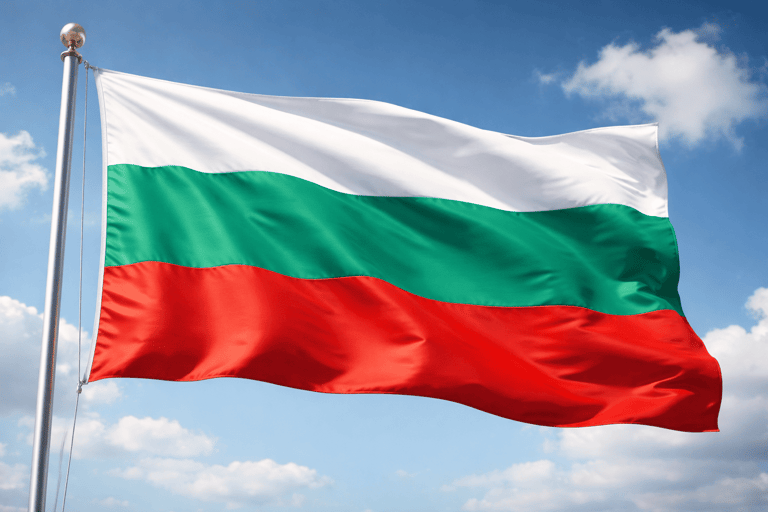
The flag of Bulgaria is one of the main state symbols of the country, well-recognized not only in Europe but also far beyond. At first glance, it appears simple: three horizontal stripes of white, green, and red. However, behind this external simplicity lies a deep historical logic connected with national revival, the struggle for independence, and the formation of Bulgarian identity.
Interest in the topic remains consistently high. Users search for how the Bulgarian flag looks, what the colors of the Bulgarian flag mean, why the Bulgarian flag resembles other European tricolors, when it was adopted, and what significance it holds today. To answer these questions fully and clearly, it's important to consider not only the appearance of the flag, but also its origin, evolution, and role in the modern culture of the country.
The modern flag of Bulgaria is not just an official banner raised at state buildings. It is a symbol of historical memory, freedom, land, and the sacrifice made for independence. This is why an article about the Bulgarian flag cannot be limited to a short description of its colors. Behind this symbol lies an entire history of the country.
How does the Bulgarian flag look?
The flag of Bulgaria consists of a rectangular banner with three horizontal stripes of equal width. The top stripe is white, the middle one is green, and the bottom one is red. This arrangement is officially recognized and is the standard version of the state flag of Bulgaria.
The aspect ratio of the modern flag of Bulgaria is 3:5. This is a classic proportion used in official state symbolism and corresponds to widely accepted international practices. Due to this format, the flag looks equally good on the facades of administrative buildings, flagpoles, documents, sports arenas, and digital images.
The main visual feature of the Bulgarian flag is its simplicity. It does not have additional emblems, intricate patterns, or decorative elements. In its modern version, the flag of Bulgaria is used without a coat of arms, which makes it easily recognizable and universal. This pure composition helps it remain one of the most memorable national flags in Europe.
If we describe the flag of Bulgaria briefly, it is a white-green-red horizontal tricolor. However, despite the brevity of this description, it is important to understand that the order of colors matters. It is not arbitrary and reflects a historical and symbolic structure that has developed throughout the national development of the country.
What colors does the Bulgarian flag have?
The colors of the Bulgarian flag are white, green, and red. They are arranged in this order from top to bottom. Queries like 'what color is the Bulgarian flag' or 'colors of the Bulgarian flag' remain popular, as this tricolor is often compared to the flags of other countries, and users want to understand its composition and symbolism accurately.
The white color occupies the top part of the banner and is perceived as the lightest and symbolically elevated element. The green occupies the center, creating visual balance. The red is at the bottom and concludes the composition, giving it strength and expressiveness. This sequence is not only aesthetic but also meaningfully structured.
Sometimes users confuse the Bulgarian flag with other tricolors, especially if they see it from a distance or in a low-quality image. However, it is the combination of white, green, and red in a horizontal format that is a characteristic feature of the Bulgarian flag. It is important not only to remember the colors but also to understand why they were chosen in this way.
What does the Bulgarian flag represent?
To understand what the Bulgarian flag represents, it is not enough just to list standard interpretations of the colors. The symbolism of the Bulgarian flag is deeply connected with the history of the country, its nature, economy, and national liberation movement. Each color carries its own weight, and together they form a cohesive image of the state.
The white color is traditionally associated with peace, freedom, and purity. In the Bulgarian context, it is particularly closely linked to the desire for independence. For a long time, the Bulgarian people were under foreign rule, and the idea of freedom became one of the central themes in the public consciousness. Thus, the white color at the top of the flag signifies liberation and hope.
The green color symbolizes land, nature, fertility, and agriculture. Bulgaria has historically been an agrarian country, and this connection with the land has long characterized the way of life for a significant part of the population. The green on the Bulgarian flag is not just an abstract natural shade, but an expression of a concrete national foundation: fertile land, rural labor, and resilience of life.
The red color is associated with courage, strength, struggle, and the blood shed for independence. It recalls the uprisings, resistance, and sacrifices without which Bulgaria's path to freedom cannot be imagined. At the bottom of the banner, the red color creates a sense of strength and historical weight upon which the state was built.
If we combine all three colors into a cohesive meaningful line, we can say that the meaning of the Bulgarian flag is connected with freedom, land, and the struggle for it. This is why the flag is perceived not just as a formal symbol, but as a visual expression of national memory.
History of the Bulgarian flag
The history of the Bulgarian flag goes back to the era of Bulgarian national revival. Prior to the emergence of the modern tricolor, various banners were used that reflected religious, military, and patriotic ideas. In the 19th century, when national liberation movements intensified in the Balkans, the question of symbolism gained particular significance. Bulgarian society needed a sign capable of uniting the people and emphasizing its right to autonomy.
The formation of the future national flag did not happen at once. Initially, various types of banners were used, often featuring images of lions, Orthodox symbols, inscriptions, and decorative details. However, as the national movement progressed, the tricolor began to acquire more significance as a form understood and modern for the European political tradition of the 19th century.
The Bulgarian flag was notably influenced by the Russian tricolor. This is explained not only by cultural and religious proximity but also by the political context of that time. However, the Bulgarian variant did not become a copy. Instead of blue, green was chosen, which better reflected the country's natural and economic specifics. This change gave the flag of Bulgaria its own identity.
After Bulgaria was liberated from Ottoman rule, the tricolor gained official status. By the end of the 19th century, it was established as a state symbol. This was an important decision because the flag had to represent the new state both within the country and on the international stage. From that moment on, the white-green-red banner began to be perceived as the official sign of Bulgarian statehood.
In the 20th century, the flag of Bulgaria underwent changes associated with political transformations. During the socialist regime, the state coat of arms was used on it, aligning with the ideological practices of that period. However, after political changes in the early 1990s, Bulgaria returned to a more concise classical version without additional symbols. The modern variant was officially adopted in 1991.
The return to a simple tricolor without the coat of arms had not only legal but also symbolic significance. It was a gesture towards historical continuity and a rejection of excessive ideological symbolism in state symbols. This is why the modern flag of Bulgaria is perceived as more neutral, clean, and close to its historical roots.
Why does the Bulgarian flag resemble other flags?
One common question is why the Bulgarian flag appears similar to the flags of other states. This impression is not accidental. In 19th century Europe, tricolors became one of the most popular formats of national symbolism. They were associated with ideas of freedom, sovereignty, and a new political order. Therefore, many countries chose this very structure.
Bulgaria entered this historical context during its national formation. Three horizontal stripes were a clear and politically relevant form. However, the Bulgarian flag still has its own character. The combination of white, green, and red in this order does not reduce to a mechanical copying of another model, but reflects specific Bulgarian meanings.
Sometimes the Bulgarian flag is compared to the Russian flag due to the common principle of the tricolor. However, the main difference lies in the colors. The Russian variant uses white, blue, and red, while the Bulgarian flag has white, green, and red stripes. It is the green color that makes it unique and emphasizes its connection to the land and nature of the country.
The similarities between national flags in Europe should not be seen as coincidence but rather as a reflection of a common era. Each state adapted the popular visual form to its own history. Therefore, the question of whether the Bulgarian flag resembles others is relevant, but the answer should always consider the national specifics and context.
When was the flag of Bulgaria adopted?
The modern form of the Bulgarian flag historically traces back to the end of the 19th century when Bulgaria began to establish itself as an independent state after liberation. The official adoption of the tricolor occurred in 1879 when it became the state symbol of the new Bulgarian statehood.
However, it is important to distinguish between the historic adoption of the flag and its modern legal affirmation. Throughout the 20th century, state symbols changed, especially during the socialist period when the coat of arms was present on the banner. The current version of the Bulgarian flag without the coat of arms was officially approved in 1991 after the political system changed.
Thus, if answering the question of when the flag of Bulgaria was adopted, one must consider two levels. Historically, the tricolor has been in use since the 19th century, while the modern form without the coat of arms was established in 1991. This is an important nuance often overlooked in brief references.
The flag of Bulgaria in different historical periods
At different stages of history, the state flag of Bulgaria has looked different, although the basic tricolor structure has been preserved. During the formation of the national state, the flag primarily served a unifying and representative function. It had to show that Bulgaria is an independent country with its own symbols and political future.
During the monarchical period, emphasis was placed on statehood and dynastic stability. The flag was already well recognized and used as the official symbol of the country. During this period, the perception of the tricolor as an integral part of Bulgarian identity was formed.
During the socialist period, a coat of arms was added to the flag. This was in line with the practices of many Eastern bloc countries, where state symbolism actively included emblems reflecting the ideological attitudes of the time. Visually, this variant appeared more complex but distanced itself from the original conciseness.
After the transition to a new political system, the classic version of the tricolor without the coat of arms was restored. This step can be seen as a return to the historical foundation of Bulgarian symbolism. The modern flag of Bulgaria thus connects the past and the present, maintaining continuity without ideological overload.
Why is there no coat of arms on the modern Bulgarian flag?
Many users wonder whether there is a coat of arms on the flag of Bulgaria. In the modern version, the answer is twofold: officially - no, historically - there used to be one. The absence of a coat of arms today is explained by the desire for a simpler and more universal symbolism, perceived as neutral and unifying for all.
The state coat of arms of Bulgaria exists as a separate official symbol, but it is not placed on the main national flag. This separation makes the flag more practical for use. It is easier to reproduce, print, scale, and use in digital environments. Furthermore, the clean tricolor is easier to remember and can be instantly recognized visually.
The symbolism without the coat of arms is also perceived as more historically authentic for a broad audience. It connects the modern state with the classical tradition of the 19th century rather than with later political changes. For this reason, the simple white-green-red variant is currently considered the main image of the Bulgarian flag.
The role of the Bulgarian flag in the modern life of the country
Today, the Bulgarian flag is used not only as a state attribute but also as an important element of public and cultural life. It can be seen on official institutions, municipal buildings, schools, diplomatic missions, stadiums, commemorative events, and national holidays.
During international sporting events, the Bulgarian flag becomes especially prominent. It is used as a sign of national support and collective identity. Fans, athletes, and diaspora representatives perceive it as a symbol of belonging to the country, rather than just a formal emblem of the state.
In the tourism sector, the Bulgarian flag also plays an important role. It is present in souvenir products, guides, on signs, and in internet materials related to the country. For foreigners, it is one of the simplest and instantly recognizable symbols of Bulgaria.
Moreover, in the digital age, interest in national flags has gone far beyond school geography lessons. Users seek the Bulgarian flag for presentations, academic works, quizzes, publications, infographics, and tourist materials. This makes the topic even more relevant for search engines and educational resources.
Interesting facts about the Bulgarian flag
At first glance, the Bulgarian flag seems too simple to build a lengthy conversation around. But it is in this simplicity that its uniqueness lies. One interesting fact is that the green color was chosen not for decorative variety, but as a meaningful replacement for blue to make the symbol more Bulgarian in content.
Another important detail is that the modern Bulgarian flag belongs to that category of state symbols that work well both in real scale and in digital format. It is equally recognizable on a large flag, on a small icon, in textbooks, in photos, and in sports broadcasts. Such visual versatility is not found in all national flags.
It is also interesting that the basic concept of the Bulgarian tricolor has been preserved for a very long time. Political regimes have changed, but the structure of the flag has remained so strong that it continues to be perceived as natural and organic for the country. This speaks to the high resilience of the symbol and its deep connection with national identity.
Furthermore, the Bulgarian flag is often studied in the context of Balkan and European symbolism. It serves as a good example of how an outwardly simple form can contain layered meaning. For this reason, the topic continues to interest not only tourists and schoolchildren but also those studying history, politics, and the visual culture of states.
The Bulgarian flag and national identity
The national flag is not just a banner raised on solemn occasions. It is one of the basic tools for shaping national identity. In the case of Bulgaria, the role of the flag is particularly significant, as the country has gone through periods of dependency, struggle, restoration, and rethinking its statehood.
The flag helps to unite the past and present. It is a reminder of national revival, liberation, the connection of the people with the land, and the price that had to be paid for the right to independence. In this sense, the meaning of the Bulgarian flag goes far beyond official protocol. It acts as a symbol of historical continuity.
For the citizens of the country, the flag may be associated with various emotions: pride, memory, respect, and a sense of belonging. For foreign observers, it often becomes the first visual sign through which they recognize Bulgaria. Therefore, the significance of the national symbol is always broader than it seems at first glance.
When the national flag maintains recognizability while not losing depth of meaning, it becomes a truly strong cultural sign. Such a sign is the flag of Bulgaria.
Why the topic of the Bulgarian flag interests users
The high interest in the topic is explained by several reasons. Firstly, people often search for basic information about the country: capital, language, coat of arms, anthem, and flag. Secondly, national symbolism is regularly used in educational content. Schoolchildren, students, and teachers seek information on how the Bulgarian flag looks, what its colors are, and what they mean.
Thirdly, the topic is particularly relevant for tourists and those interested in the history of the Balkans. The flag is a simple entry point into a broader conversation about the country. Through it, one can delve into exploring national character, historical stages of development, and cultural memory. That is why articles about the Bulgarian flag work well not only as reference material but also as full educational content.
Finally, flags generally sustain enduring interest in searches because they are easily visualizable, often compared, and quickly recognized. But for this reason, it is not the material that simply lists the colors that prevails; rather, it is that which reveals the meaning, context, and history. For the topic of the 'Bulgarian flag', this is particularly important.
How the Bulgarian flag differs from other tricolors
Although the tricolor format is widely used, the Bulgarian flag has its own unique intonation. Firstly, the green stripe plays a crucial role, setting it apart from many other red-white or blue-red combinations. Secondly, the symbolism of the colors in the Bulgarian context is closely linked to the land and struggle, giving it a specific national depth.
It's also important that the modern Bulgarian flag is stripped of additional elements. It has no coat of arms, motto, or complex emblems. This distinguishes it from many states that make their flags visually heavier. The Bulgarian version benefits from clarity and simplicity.
Another distinction lies in the stability of the image. Even people who do not know the country's history well can quickly remember the Bulgarian flag thanks to its clean composition. It is an excellent example of how a national symbol can be simple, expressive, and filled with meaning.
The flag of Bulgaria in education, culture, and media
The national flag is actively used in educational settings. It is studied in schools during history, geography, and social studies classes. Through the description of the flag, broader themes are often explained: national rebirth, symbolism of states, features of European history, and the processes of forming modern nations.
In cultural environments, the Bulgarian flag is present in art exhibitions, festive events, memorial actions, and public celebrations. It helps visually unify the audience and quickly designate the national context of the event. In media and digital spaces, the flag also remains in demand—from news publications to infographics and visual guides.
Media recognition is particularly important. In a context where information is perceived quickly and often through images, a strong and clear national symbol gains an additional advantage. The Bulgarian flag is highly effective in this regard: it is easy to reproduce, easy to recognize, and easy to associate with the country.
What is important to remember about the Bulgarian flag
If we boil down the topic to a few key points, it is essential to remember the following. The Bulgarian flag is a white-green-red horizontal tricolor. The white color symbolizes freedom and peace, green is associated with the land and nature, and red stands for struggle and sacrifice. The modern version of the flag is used without a coat of arms and is the official symbol of the country.
Historically, the Bulgarian flag dates back to the 19th century and is linked to the era of national awakening and the struggle for independence. Its modern form without a coat of arms was established in 1991. Despite its outward simplicity, this symbol carries deep historical and cultural weight.
That is why an article about the Bulgarian flag can be both reference material and educational. It helps not only to learn what the state symbol looks like but also to better understand the country, its past, and its values.
Conclusion
The Bulgarian flag is an example of how a concise visual image can contain rich historical and cultural significance. The three stripes of white, green, and red reflect not only the official state symbolism but also the crucial ideas upon which Bulgarian national consciousness is built: freedom, connection to the land, and readiness to fight for one's own future.
It has gone through different eras, maintaining its essence and not losing its recognizability. This makes the Bulgarian flag a strong and durable symbol. Its simplicity is not a sign of impoverished imagery but rather a result of precise and fortunate choices. Thanks to this, the Bulgarian flag remains understandable, relevant, and significant both for Bulgarians themselves and for those who want to delve deeper into the country's history and culture.
When considering national symbols not as a formality but as a concentration of historical memory, the Bulgarian flag becomes particularly interesting. It does not merely represent the country—it tells a story about it.