

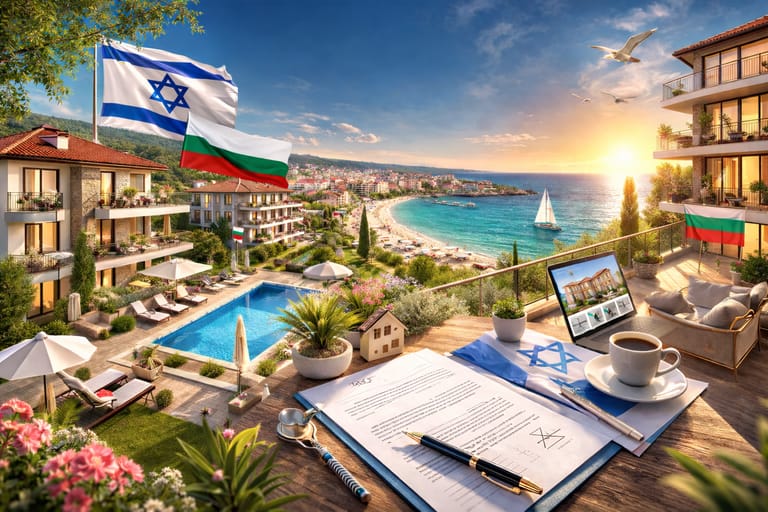
In brief: In 2026, Bulgaria remains one of the most straightforward markets in the EU for Israelis: transactions are formalized with a notary and mandatory registration of property rights, payments are typically tied to the euro, and annual ownership taxes are relatively low. For investors, key strategies include long-term rentals in major cities and seasonal rentals by the sea/in the mountains, but profitability depends on management and actual occupancy rates. For retirees, infrastructure, healthcare, and year-round availability of the area are more important than 'first line'. Purchasing real estate does not automatically qualify for residency — this must be planned separately according to applicable regulations.
This article is useful for Israeli citizens considering Bulgaria as a place to purchase an apartment/house, generate rental income, or enjoy peaceful retirement living. We will discuss what is happening in the market in 2026, which locations are most frequently chosen, how notary transactions are structured, what costs and taxes to factor in, and where mistakes are commonly made.
The Bulgarian Real Estate Market in 2026: What Israelis Need to Understand
The Bulgarian market remains 'European' in its procedures: property rights are recorded in the Property Register (state register), and the key document of the transaction is the notarial deed. This reduces legal risks compared to jurisdictions where property registration is less transparent. Checking the property and documents before the transaction is critical: it is at the due diligence stage that issues with ownership, encumbrances, and construction status are filtered out.
Prices and demand vary greatly by region: the capital and major cities experience year-round demand, while resorts have seasonal demand. If the goal is investment, liquidity, type of rental, maintenance costs, and resale potential are more important than a 'pretty price per m²'.
Where Israelis Buy: Locations for Different Goals
Sofia — for rental and capital preservation
Sofia is most often chosen for long-term rentals: demand is supported by jobs, universities, and internal migration. Important factors include transport, job clusters, metro access, and house quality. For investors, this is typically a more predictable strategy than seasonal resort rentals.
Varna and Burgas — the sea, but with a 'year-round' logic
If the goal is to live there or rent out, consider not only proximity to the beach but also winter infrastructure: supermarkets, healthcare, transport, parking, humidity/wind, and heating quality. In coastal cities, liquidity is generally higher than in purely resort complexes that 'freeze' out of season.
Plovdiv — a balance of price, city, and rental
Plovdiv is often chosen by those seeking a calm large city with more affordable entry than the capital. Key factors for long-term rentals include the neighborhood and transport accessibility.
Resorts (Black Sea and Mountains) — only considering seasonality
Purchasing in resorts makes sense if you are prepared to manage the property as a business: marketing, cleaning, repairs, working with a management company, and a realistic assessment of occupancy rates. Without management, 'high yield' remains at the level of expectations.
Purchase Conditions for Israeli Citizens: What is Allowed and What Requires Structuring
Citizens of third countries (including Israel) can purchase apartments and properties in buildings in Bulgaria in their name. The situation with land is more complex: ownership rights to land for third-country nationals are restricted, so purchasing a house with land is often structured through a Bulgarian company. This is a legally common model, but it requires competent support: corporate documents, accounting, annual obligations, and the correct ownership structure.
Transactions in Bulgaria are formalized with a notary. Ownership rights must be registered in the Property Register (Registration Agency). It is the registration that makes the right enforceable against third parties and serves as the basic point of legal protection for the owner.[1]
Prices and Costs in 2026: What to Budget For
There are various price ranges in the market by cities and types of properties, but precise figures can only be accurately assessed based on the specific area, year of construction, and condition. We recommend focusing not on 'average city prices', but on comparable transactions of 5-10 similar properties and the actual cost of ownership.
One-time Purchase Costs
Basic costs include: notary fees, local tax on the purchase (collected by the municipality), registration fees, and, if necessary, translation and legal services. Local tax rates and part of the fees depend on the municipality and the price of the transaction, so the final calculation is made for the specific property. Notary fees are regulated by the official tariff.[2]
Annual Taxes and Maintenance
Annually, the owner pays property tax and waste collection fees (municipal fees). Specific rates are set by municipal councils under the law, so they vary by city and even by zones.[3]
If the property is in a complex, a maintenance/support fee (management company) is added. This is no longer a governmental tax but a contractual payment: it needs to be verified in the management contract, and it should be clarified what is included (security, pool, elevator, cleaning common areas, repair fund).
New Build in Bulgaria: Acts 14/15/16 and What They Really Mean
If you are considering a new build, it is important to understand the stages of commissioning. In Bulgaria, the terms 'Act 14', 'Act 15', and 'Act 16' are widely used as stages of construction and acceptance. The final permit for use (commonly referred to as 'Act 16') is the key document confirming that the property can be used for its intended purpose. You need to check not 'promises' but the presence of documents and the status in official papers concerning the property, including the construction permit and acceptance/commissioning documents.[4]
Practical nuance: banks, insurers, and tenants perceive properties without final input differently. Therefore, for investments and relocation, it is safer to choose properties with a clear operational status or with understandable timelines and guarantees.
Investments: rental, profitability, and realistic scenarios
Long-term rent (city)
Pros - stable demand and fewer seasonal downturns. Cons - tenant quality, contracts, deposits, eviction timelines, and legal discipline are more important. Actual profitability depends on: entry price, vacancy periods, repairs, taxation, and management.
Short-term rental (resorts)
Pros - potential for higher revenue in season. Cons - strong dependence on seasonality, competition, ratings, cleaning, and management costs. In modeling calculations, we always assume conservative occupancy and a separate line for repairs after the season.
Residency permits and real estate: important clarification without illusions
Purchasing property in Bulgaria can be part of a relocation strategy (as proof of address, financial stability, and intentions), but it is not a universal "automatic" basis for a residency permit. Grounds and requirements are determined by the Foreigners Act in the Republic of Bulgaria and subordinate legislation, as well as the practices of migration authorities. Before purchasing for residence permits, it is essential to verify the current category, document package, and processing timelines.[5]
For retirees and families, we usually recommend first determining the immigration goal (long-term residence, frequent visits, study, business), and only then selecting a property for the right scenario.
Practice: what to check before a transaction (and where mistakes often occur)
Property verification checklist
- Ownership rights and history of transfers: who is the owner, on what basis, are there co-owners, heirs.
- Encumbrances: mortgages, bans, legal disputes, leases, easements - checked against registers and documents.
- Compliance of the property with documents: area, purpose, boundaries, common parts.
- Construction status (for new buildings): construction permit, stage, acceptance/commissioning documents.[4]
- Ownership expenses: municipal taxes/fees, maintenance fee, repair fund, utilities.
- If the house is with land: determine ownership structure and legal consequences in advance (often through a company).
Common mistakes by buyers from Israel
- Purchasing "by photo" without a technical inspection and checking humidity/heating (especially by the sea).
- Underestimating the maintenance fee in complexes and the conditions for its change.
- Expecting high profitability without a cost model and considering vacancy.
- Confusion over new building status: "almost ready" does not equal permission for use.
- Trying to tie residency permits to purchases without consulting on the current grounds and documents.[5]
Risks and pitfalls
The key risk is not the price, but legal clarity and liquidity. The second most important is operating costs and management quality (especially in resort properties). Third is currency and banking nuances in transfers: coordinate the origin of funds and payment procedures with the bank in advance to avoid disrupting transaction timelines.
Pros and cons of buying property in Bulgaria for Israelis
Pros
- European legal environment: notarized transaction and state registration of ownership rights.[1]
- Relatively low annual property taxes and clear municipal fees (rates depend on the city).[3]
- The opportunity to diversify capital in a European jurisdiction and earn rental income with the right management model.
- For retirees - a more relaxed pace of life and generally more affordable services compared to Israel (needs to be assessed based on specific cities and requirements).
Cons
- Resort seasonality: without management and marketing, profitability may be below expectations.
- Nuances of land ownership for citizens of third countries: sometimes a structure through a company is required.
- The quality of construction and management of complexes varies significantly - professional selection is needed.
- A residency permit cannot be "guaranteed" by a single purchase: an immigration strategy should be a separate project.[5]
Output: how to act in 2026 (Inreal4u recommendation)
Real estate in Bulgaria In 2026, for Israelis — a working tool: for rental investments, for living by the sea or in the city, and as part of a relocation strategy. But the outcome depends on three things: the right location for the purpose, a legally clean transaction, and a realistic ownership financial model.
Inreal4u recommendation: start with defining the task (investment/move/retirement), then select 2–3 locations, after which make selections only with verification of documents, construction status, and calculation of all expenses. We support transactions for Israeli citizens: selection, negotiation, legal verification, organization of a notary, and remote purchase by power of attorney — so that you understand every step and every figure before signing.
Sources
- Registry Agency — Property Register
- Notarial Chamber of the Republic of Bulgaria — information and tariffs (official resource)
- Law on Local Taxes and Fees (LTTF) — legal framework for local taxes and fees
- Ministry of Regional Development and Public Works (MRRB) — regulatory framework for construction and commissioning
- Law on Foreigners in the Republic of Bulgaria — grounds and regimes for residence/occupation