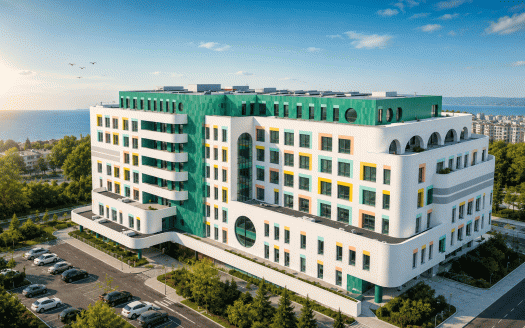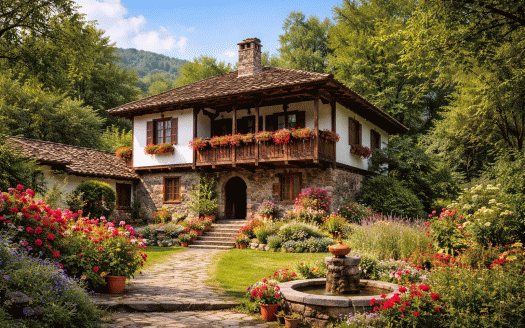

The main change in recent years is that Bulgaria has ceased to be merely cheap and has become segmented: different cities and areas operate by their own rules.
The real estate market in Bulgaria has transitioned over the past few years from being a "cheap alternative to Europe" to a fully developed market with rising prices, competition, and noticeable differences between regions. Whereas 5–10 years ago the country was viewed as a place to buy a seaside apartment for minimal money, in 2026 such an approach no longer works.
Today Bulgaria is a market where it is important to understand not just the price, but also the context: where the property is located, who will buy it after you, is there demand for rental, and how liquid the location itself is. Without this, even a cheap purchase can turn out unprofitable.
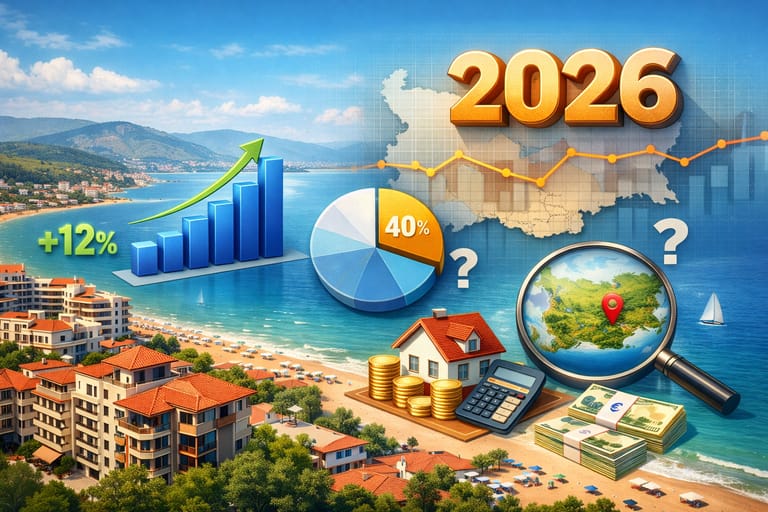
According to the National Statistical Institute of Bulgaria, in 2025 the market showed double-digit growth — about 12.6% year-over-year. This means that the country is no longer in a "frozen market" phase, but is actively developing and gradually catching up with other European countries in terms of housing costs.
That is why it is no longer possible to speak of an "average price across the country" as something real. Sofia, Varna, Burgas, resorts and rural real estate are different markets with different logic.
Overall situation on the Bulgarian real estate market
Looking at the market as a whole, it is in a growth phase, but this growth is no longer chaotic. It is concentrated in places where there is real demand: large cities and liquid coastal areas.
Sofia remains the country's most expensive market — about 2,500 euros per square meter in the mid-range segment. Varna holds at around 1,800–2,000 euros, while Burgas is about 1,500–1,800 euros per square meter.
Meanwhile, resort areas show a much wider range of prices — from budget options to properties with prices comparable to urban housing.
Why prices in Bulgaria have risen
The price increase is the result of several factors: active mortgage lending, the country's transition to the euro, and the concentration of demand in specific regions.
This means that the market is no longer growing uniformly — and the choice of property is becoming a key factor for success.
Market segmentation: where one market ends and another begins
Today Bulgaria can be conditionally divided into three segments: large cities, resorts, and the low-cost segment.
And while the first two may be interesting from an investment perspective, the third is often associated with low liquidity.
Real estate by the sea: expectations and reality
Purchasing real estate by the sea is one of the most popular goals. However, it's important to understand that this is not always an investment.
The rental season is limited, competition is high, and expenses can significantly reduce profitability.
That is why it is important to choose not just a "seaside apartment", but a liquid property with a clear perspective.
Where in Bulgaria is real estate genuinely cheap
The cheapest properties are found in remote areas, old stock, and rural locations. However, low prices are almost always associated with risks: weak demand, poor infrastructure, and difficult resale.
The real cost of purchasing
In addition to the property's price, it is necessary to consider taxes, notary fees, registration, and legal support.
As a result, the actual budget for the deal is always higher than the stated price.
Investments: where they work and where they don't
In 2026, investments in Bulgaria require a more precise approach.
The most stable segments:
- Sofia — rental and liquidity
- Varna and Burgas — balance of life and investments
- quality complexes by the sea
Less reliable:
- cheap properties
- weak locations
- overcrowded resorts
Buyers' Mistakes
The most common mistakes are purchasing without analysis, focusing only on price, and ignoring expenses.
These factors often lead to disappointment.
How to approach real estate purchase correctly
In 2026 purchasing real estate in Bulgaria requires not just choosing a property, but understanding the strategy. It's important to answer key questions in advance: what is the purpose of the property, what is the planned ownership duration, will the property be used for rental or only for personal residence.
It's also important to consider liquidity—how easy it will be to sell the property in the future. This factor is often ignored, although it is key for investments.
Practice shows that properties in clear and sought-after locations, with good infrastructure and real demand, perform best.
Conclusion
The real estate market in Bulgaria in 2026 has matured. It is no longer about 'cheap apartments by the sea', but about choice, calculation, and strategy.
This does not mean that opportunities have decreased—instead, they are still present. But now they require a more attentive approach.
That is why more and more buyers are turning to market professionals who understand where truly liquid properties are located and where there is simply a low price without prospects.
Real estate agency inreal4u operates exactly with this approach: not just selection of options, but market analysis, location verification, and assistance in choosing properties that have real potential—both for living and for investment.
This is especially important in conditions where the market has become more complex, and the difference between a successful purchase and a mistake can be measured in years and tens of thousands of euros.
The main takeaway: it is still possible to buy real estate profitably in Bulgaria, but only if approached not as a random purchase, but as a conscious investment decision.
Sources used:
- National Statistical Institute of Bulgaria (NSI)
- Bulgarian National Bank (BNB)
- Real estate agency analytics
- Market data from listing platforms
- Ministry of Finance of Bulgaria
- International reports on the investment climate